| Provenance |
Coll. Koning Karel I van Engeland, toen hij Prins van Wales was, voor 1625
Door hem "uitgewisseld" aan Thomas Howard, Earl of Berkshire, 1625;
Coll. Dr. C. Zumloh, Wesermünde
Vlg. London (S), 4-7-1990, lot 21 [aldaar gekocht door huidige eigenaar volgens cat. vlg. Londen, (S) 5-7-2006];
Coll. R. Feigen, New York [volgens cat. Rafael Valls: 2004 recent acquisitions]
Khdl. Rafael Valls 2004 [2005?]
Vlg. Londen (Sotheby's Bond Street), 5-7-2006, lot 23;
Khdl. Richard L. Feigen , New York, maart 2009 (te zien op TEFAF Maastricht 2009); |
| Opmerkingen |
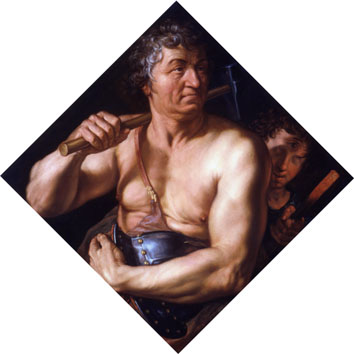
Volgens Van der Doort had het schilderij oorspronkelijk een ruitvormig pendant, namelijk Vulcanus’ vrouw Venus, die een brandend hart in haar hand houdt. Wat betreft formaat en stijl is "Vulcanus" verwant aan twee andere ruitvormige pendanten uitgevoerd door Goltzius in 1616: "De Beproeving van Job" (New York, Metropolitan Museum) en "De Beproeving van Christus" (Ulzen, St. Marienkirche).
Tekst cat. Vlg. Londen (Sotheby's), 5-7-2006, lot 23:
Though recorded in Van der Doort’s inventories of Charles I’s collection, this picture was unknown until its rediscovery prior to being sold in these Rooms in 1990. Though recognisably of diamond or lozenge-shape, it had been made up to a rectangle, with indications of Vulcan’s costume crudely painted on the added triangles of canvas below (see fig. 1). Subsequent cleaning revealed Goltzius’ monogram and the date 1615, and the picture was restored to its original lozenge format by the removal of the additions and the lining canvas. The lozenge shape enjoyed some considerable local popularity in Haarlem, and Goltzius as well as his townsman Cornelis van Haarlem used it on a number of occasions. Its shape may have derived from the painted armorial shields or blazons that hung from the piers in Dutch churches. The present picture is closely related to a pair of lozenge-shaped pendants painted by Goltzius the following year, 1616, depicting Job in Distress and Christ in Distress.1 In all three pictures, massive semi-nude figures are set close to the picture plane against a neutral dark background, and each fills the composition to its limits. All three are strongly lit, with ruddy flesh tones and fluid brushwork, characteristics which may perhaps reflect the influence of Rubens.
Goltzius made several portraits of his friend and patron Jan Govertsz. van der Aar (1544-1612), of whom portraits are also known by Cornelis van Haarlem and Jan Muller.2 Only one of Goltzius' portrayals is a formal painted portrait: the picture of 1603 in the P. & N. de Boer Foundation, on long-term loan to the Museum Boymans-van Beuningen in Rotterdam.3 As can be seen from both this and the Rotterdam portrait, Van der Aar was a stocky, thick-set man, with a powerful neck ringed with creases, mouth turned down each side with jutting lower lip, a prominent nose, deep-set eyes, a forehead with lines rising over each eyebrow, and greying curly hair. The present picture, painted three years after Van der Aar’s death, but portraying him as he looked another ten years earlier, is a little more flattering than the formal Rotterdam portrait, and Goltzius has portrayed Van der Aar, or rather his head and neck, in the same heroic manner as an antique sculpted portrait bust of a Roman emperor. The formal source for the composition however, was Michelangelo’s sculpture of Moses in S. Pietro in Vincoli, of which Goltzius made a black chalk drawing during his visit to Rome in 1591.4 In making it, he was clearly attempting to capture the vigour of the marble which he drew with thick powerful strokes of black chalk.
There is no obvious reason why Goltzius should have portrayed Van der Aar in the guise of Vulcan. Van der Aar’s family wealth came from textiles, and he was probably a cloth merchant. Goltzius’ Rotterdam portrait shows him as a conchologist, holding a fine specimen of a moon shell. Cornelis van Haarlem included him in his Allegory of the Arts and Sciences of 16075 [sic, SH], and Goltzius included his likeness in several paintings and drawings. While it may seem strange to us that Goltzius would have painted an allegorical portrait of Van der Aar three years after his death, he had already used Van der Aar’s likeness in a finished pen drawing of Saint Luke in 1614, where however Van der Aar is depicted as an older man than he is in the present picture 6 It is a moot point whether Goltzius intended the present picture to be a portrait, or whether he used the physiognomy of his late friend and patron in a depiction of Vulcan.
Van der Doort records two pictures by Goltzius which had earlier left the collection: "One being a fat Vulcan with a hammer in his hand; the other a fat Venus holding in her hand a flaming heart, so big as the life, set in a black and white gilded quarrel manner frame upon boards, painted by Henry Goltzius".7 Van der Doort’s entry is for a double portrait of Titian and Pietro Aretino by Quentin Massys, which Charles I had acquired by exchange when still Prince of Wales - so before he ascended the throne in 1625 - with my Lord of Berkshire (Thomas Howard). Charles gave in exchange for the Titian two pictures by Goltzius, the present work and a Venus holding a flaming heart, now lost. The description of the frame - quarrel manner - implies that both paintings were lozenge or diamond shaped.
This picture will be included in Dr. Nichols' forthcoming catalogue raisonné of Goltzius' paintings.
2. See L.W. Nichols, "Jan Govertsz. van der Aar: on the identification of Goltzius' patron", in Nederlands Kunsthistorisch Jaarboek, vol. 38, 1987, pp. 241-255.
3. See L.W. Nichols, in H. Leeflang & G. Luijten, Hendrick Goltzius (1558-1617). Drawings, Prints and Paintings, exhibition catalogue, Zwolle 2003, pp. 286-8, no. 104, reproduced.
4. See E.K.J. Reznicek, Die Zeichnungen von Hendrick Goltzius, Utrecht 1961, vol. I, p. 340, no. K232, reproduced vol. II, plate 185.
5. Now at Knole (Kent), collection of Lord Sackville; see Nichols, op. cit., 2003, reproduced p. 286, fig. 104a.
6. The drawing is at Coburg; see Reznicek, op. cit., vol. I, pp. 257-8, no. K70, reproduced vol. II, plate 442.
7. George Vertue’s transcription of Van der Doort’s manuscript, transcribed in The Walpole Society; see O. Millar, under Literature. Afmetingen volgens http://www.rkd.nl/rkddb/(lx2ngmj4jvvcfn45cqqbgg55)/detail.aspx?parentpriref= (4-2-2008), afmetingen vermeld door kunsthandel R. Valls: 61,3 x 62,2 cm. |